“Aren’t I a bit old for that?”
It’s one of the most common questions people in their sixties, seventies and beyond ask about dental implants. Often it comes after years of a denture that slips when they eat, clicks when they talk, or stays in a glass by the bed because it’s simply easier without it.
It’s an understandable worry. Implants involve minor surgery and some healing time, and it’s natural to wonder whether that’s worth doing later in life.
The short answer: for most people, no, it isn’t too late. Research consistently shows that age on its own doesn’t make implants less successful. What matters far more is your general health, the bone in your jaw, whether you smoke, and whether you can look after the implants once they’re in.
What the research says about age
This is one area of dentistry where the evidence is reassuring and consistent:
- A 2025 systematic review in Clinical Oral Implants Research compared implant survival in people aged 65 to 75 with people over 75. The over-75s actually had higher five-year survival: 96.8%, compared with 92.1%.
- An earlier review of patients aged 75 and over found 97.3% of implants survived the first year and 96.1% were still in place after five years.
- The International Team for Implantology (ITI), a leading international expert body, has issued a consensus statement that advanced age alone, 75 and over, is not a reason to rule out implant treatment. It recommends an individual risk assessment for anyone with other health conditions.
In other words, a healthy 78-year-old may be a better candidate than a 45-year-old who smokes heavily. Your birthday isn’t the deciding factor.
What matters more than your age
At a consultation, your dentist will look at your overall health and your mouth, not just your date of birth. These are the factors that make the real difference:
| Factor | Why it matters | What usually happens |
| Smoking | Smoking reduces blood flow and slows healing. A large meta-analysis found smokers had roughly twice the risk of implant failure. | Stopping, or at least cutting down, before and after treatment improves your chances. |
| Diabetes | Poorly controlled diabetes can slow healing and increase infection risk. Well-controlled diabetes generally isn’t a barrier. | Your dentist will ask how well your blood sugar is controlled. |
| Osteoporosis and bone medicines | Osteoporosis itself doesn’t appear to stop implants working. Some bone-strengthening medicines, especially bisphosphonates, carry a small risk of a rare jaw-bone healing problem after surgery. | Tell your dentist about every medicine you take. They’ll weigh the risk with you, and may speak to your GP. |
| Radiotherapy to the head or neck | Past radiotherapy in this area raises the risk of implant problems. | Usually needs specialist planning. |
| Gum disease | Active gum disease can affect the bone around implants. | Gum health is treated and stabilised first. |
| Bone in the jaw | Implants need enough bone to anchor into. | Bone can often be rebuilt with a graft (see below). |
| Looking after them | Implants need daily cleaning and regular hygiene visits. | Your dentist will show you how and suggest aids if your hands are stiff. |
None of these is automatically a “no”. They’re things to plan around, and a good dentist will be honest if the risks outweigh the benefits for you.
“I’ve worn dentures for years. Is there enough bone left?”
This is a very fair question. When a tooth is lost, the bone that held its root no longer gets stimulated by chewing, and it gradually shrinks. That’s why long-term denture wearers often find their dentures get looser over the years: the ridge of bone underneath has slowly changed shape.
It doesn’t necessarily rule implants out:
- X-rays and digital scans show exactly how much bone you have and where, so the implant can be planned precisely.
- A bone graft can rebuild areas where the bone has thinned.
- A sinus lift can create more height in the upper back jaw, where the bone sits close to the sinus.
The flip side is worth knowing too: once an implant is in, it helps protect the surrounding bone from shrinking further, something a conventional denture can’t do.
Your options, from one tooth to a full set
Implants aren’t one single treatment. The right option depends on how many teeth are missing and what you want day to day.
A single implant
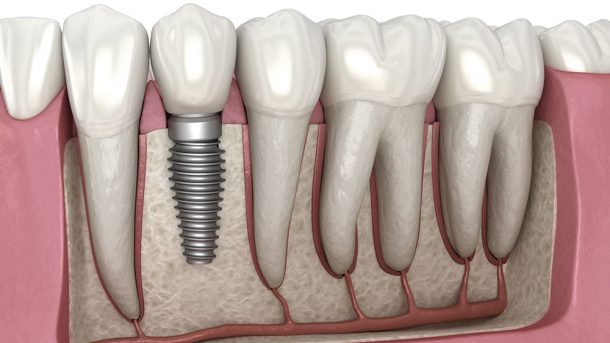
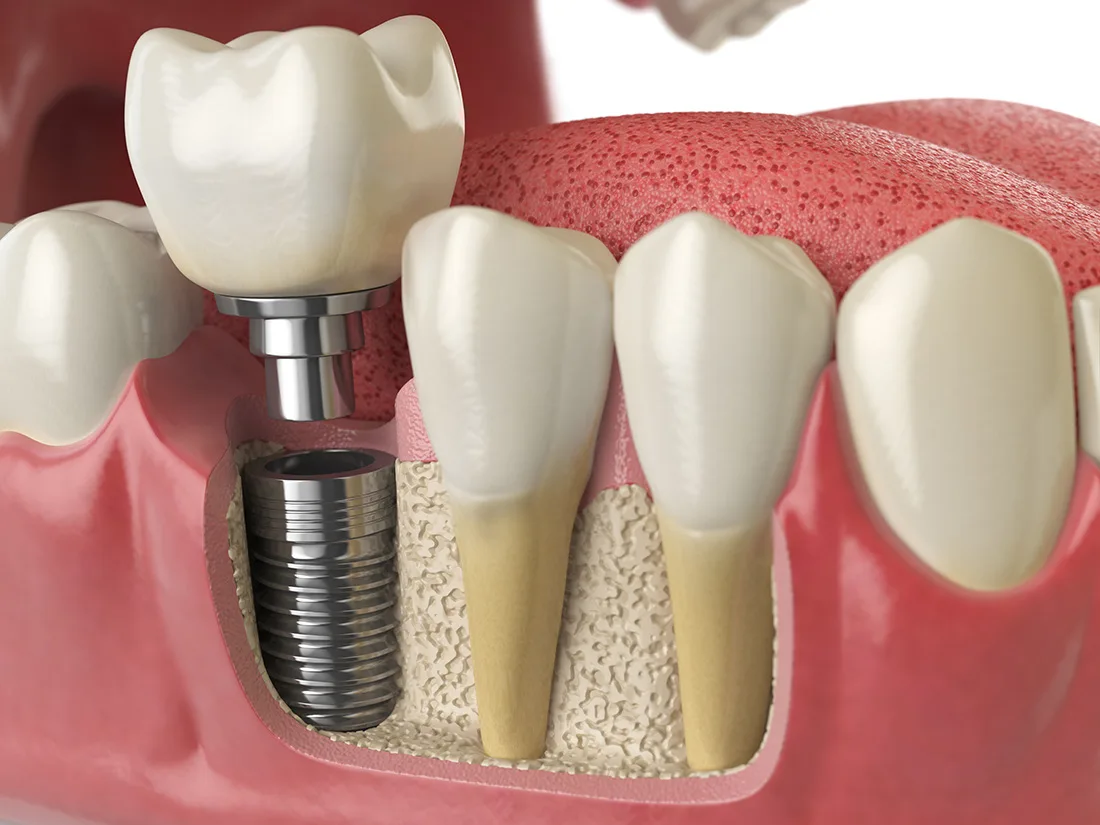
One implant replaces one missing tooth. A small titanium post goes into the jawbone, the bone bonds to it over the following months, and a custom crown matched to your other teeth is fitted on top. Unlike a bridge, it doesn’t rely on the neighbouring teeth for support.
An implant-supported bridge
If several teeth in a row are missing, two or more implants can hold a bridge of replacement teeth, without needing an implant for every tooth.
Implant-retained (“snap-on”) dentures
This is often the most life-changing option for long-term denture wearers. A small number of implants hold your denture firmly in place. It still comes out for cleaning, but it doesn’t rock, slip or need adhesive.
The evidence for this is strong, particularly for lower dentures, which tend to be the least stable. In 2002, an international panel of experts at McGill University concluded that a conventional lower denture should no longer be the first-choice treatment for people with no lower teeth, and that a denture held by two implants should be. A follow-up statement in 2009, known as the York consensus, pointed to evidence that patients are significantly more satisfied with implant-retained lower dentures than with conventional ones.
A full fixed arch
For people missing most or all of their teeth in one jaw, a full arch of teeth can be fixed permanently onto several implants. You can’t take it out yourself, and it’s the closest feeling to having your own teeth back.
Implants, dentures or a bridge: how they compare
| Dental implant | Implant-retained denture | Conventional denture | Conventional bridge | |
| How it stays in | Fixed into the jawbone | Clips onto implants | Rests on the gums; may need adhesive | Cemented to the teeth either side |
| Eating | Like natural teeth | Much more secure than a standard denture | Can slip; harder foods are often avoided | Good |
| Effect on jawbone | Helps preserve it | Helps preserve it where the implants sit | Bone continues to shrink | Bone under the gap continues to shrink |
| Effect on other teeth | None | None | Partial dentures can put strain on the teeth they clip to | Neighbouring teeth are usually shaped to hold it |
| Upfront cost | Highest | Moderate to high | Lowest | Moderate |
| Treatment time | Months, including healing | Months, including healing | Weeks | Weeks |
Dentures cost less upfront and suit some people perfectly well. But if your current denture is limiting what you eat, how you speak or how often you smile, implants are worth a conversation, whatever your age.
What treatment involves, step by step
At our practice, a single implant typically follows these steps:
- Consultation and assessment. We look at your general health, medicines, gums and bone, and take X-rays and digital scans. You get a written treatment plan with the full fees before anything goes ahead.
- Placing the implant. This is done under local anaesthetic, so the area is completely numb. A single implant usually takes around 60 to 90 minutes. If you feel anxious, we’ll go at your pace, explain each step and stop for breaks whenever you need.
- Healing. The implant then needs around three to six months to bond with the bone. A temporary tooth protects the area and keeps your smile looking natural in the meantime.
- Your new tooth. Once healing is complete, a connector called an abutment is attached and your permanent crown is fitted, matched to the shape and shade of your own teeth.
In some cases, an implant can be placed at the same appointment a tooth is removed, which shortens the overall timeline. Whether that’s possible depends on the health of the bone and gum.
What recovery feels like
The procedure itself shouldn’t hurt. Afterwards, some tenderness and mild swelling are normal for a few days, and most people manage them with paracetamol or ibuprofen. Many patients are pleasantly surprised by how little discomfort they feel.
What it costs, and is it worth it?
Dental implants are generally not available on the NHS, so they’re almost always private treatment. At One Two Three Dental:
| Treatment | From |
| Single implant | £2,095 (crown, bridge or denture on top priced separately) |
| Full arch of implant-supported teeth | £16,995 |
| Partial denture, for comparison | £1,200 |
You’ll get a written quote before any treatment begins, and 0% finance can spread the cost.
Is it worth it at 60, 70 or 80? That’s a personal decision, but it helps to think about it this way:
- Time: with good care, implants can last for decades. The crown on top may need replacing after around 10 to 15 years through everyday wear.
- Daily life: many people underestimate how much a loose denture affects what they eat, how they speak and how often they smile, until it’s fixed.
- Your bone: implants help preserve the jawbone, which affects how well any future teeth or dentures fit.
For some people, a well-made conventional denture is the right answer. For others, especially those whose denture causes daily problems, implants can make an everyday difference for many years.
Looking after implants in later life
Implants can’t decay, but the gum and bone around them can become inflamed if plaque builds up. This condition, called peri-implantitis, is one of the main reasons implants run into trouble years later. The good news is that it’s largely preventable:
- Brush twice a day around the implant just as you would a natural tooth.
- Clean between the teeth every day with interdental brushes or floss.
- Keep up regular hygiene appointments so any early inflammation is caught and treated.
- Don’t skip check-ups, even if everything feels fine.
If arthritis or stiff hands make cleaning harder, small changes help: an electric toothbrush with a chunky handle, interdental brushes with longer grips, or a water flosser. Ask your hygienist to show you which suits your hands.
It’s also sensible to plan ahead. If you might one day need help from family or carers with daily cleaning, an implant-retained denture that clips out can be easier to keep clean than a fixed bridge. That’s worth discussing with your dentist at the planning stage.
Questions to ask at your consultation
Take this list with you:
- Am I a good candidate, given my health and the medicines I take?
- How much bone do I have? Will I need a bone graft or sinus lift?
- Which option would you recommend for me, and why?
- How many appointments will I need, and how long will the whole process take?
- What will I have in place of the missing teeth while I heal?
- What’s included in the quote, and what could cost extra?
- How do I look after the implants, and how often will I need hygiene visits?
- What happens if something goes wrong later?
A good dentist will welcome these questions and give you straight answers, including if they think implants aren’t the right choice for you.
Your next step
If you’ve been putting up with a loose denture or a gap you avoid showing, your age is very unlikely to be the thing standing in the way. The questions that really matter are about your health, your bone and what you want from your teeth, and only a proper assessment can answer them.
If you’re near Guiseley, Yeadon, Menston, Rawdon or Otley, you can read more about dental implants in Guiseley at One Two Three Dental, including single implants, full-arch options and implant-retained dentures.
Dental implants after 60: FAQs
Is there an upper age limit for dental implants?
No. Research shows age alone doesn’t reduce implant success, and international experts agree it isn’t a reason to rule implants out. Your general health, bone and ability to keep the implants clean matter much more.
Does getting an implant hurt?
The procedure is done under local anaesthetic, so you shouldn’t feel pain during it. Afterwards, tenderness and mild swelling for a few days are normal and usually settle with paracetamol or ibuprofen.
Can I have implants if I take medicine for osteoporosis?
Often, yes. Osteoporosis itself doesn’t appear to stop implants working. Some bone-strengthening medicines, particularly bisphosphonates, carry a small risk of a jaw-bone healing complication, so tell your dentist about every medicine you take. They’ll assess your individual risk and may consult your GP.
Can I have implants if I’m diabetic?
Usually, if your diabetes is well controlled. Poorly controlled blood sugar can slow healing, so your dentist will ask about your recent control before planning treatment.
How long do dental implants last?
With good care, implants can last for decades. The crown on top may need replacing after around 10 to 15 years through normal wear.
Can my existing denture be fixed to implants?
Sometimes. In some cases a well-fitting existing denture can be adapted to clip onto implants; in others a new denture is made. Your dentist can tell you which applies after examining you.